Showing posts with label short and tweet. Show all posts

Sunday, 1 April 2012

Black Bread - Short and Tweet


This week's selection included suggestions for a number of different breads from @EvidenceMatters - you can find the Short and Tweet schedule for April here. You can find out more about the challenge and how to participate here. So this week's selection included Spelt and Ale loaf (I've just finished my spelt flour!), Walnut loaf (out for obvious reasons round this way), Soya and Linseed Loaf (I have recently baked, but not blogged about a soya containing loaf so didn't want to duplicate the bread in my freezer), Multigrain and Honey loaf and Black Bread. Both of these remaining breads included ingredients I'm really not sure that I'm keen on. I don't really do seeds very much and the Black Bread is full of slightly weird and wonderful ingredients.

Having recently aquired some caraway seeds I decided that it would be the Black Bread for me. Helpfully it didn't require the sponge stage that the multigrain and honey loaf needs. Helpful because I am not organised and have only just finished baking this loaf!


The loaf derives the intense black colour from a mixture of rye flour (although you can choose rye, spelt or wholemeal), black treacle, cocoa powder and instant coffee powder, plus there are additional flavours from the seeds - caraway, fennel and cumin are the suggestions so I decided on caraway. There is also an option on the starchy root vegetable too - carrot is suggested and is what I used, but I'm sure that parsnip, swede, turnip or even potato would work equally well. I guess that with all of these variations each loaf of black bread will be fairly unique to the baker making this particular recipe.

I halved the recipe - partly due to storage issues (again) and partly because I'm not sure that I'll like the end result! Having said that, when I halved the ingredients I was mean with the seeds, using just a scant tsp, mean with the coffee, using just over a half a tsp instant espresso powder (I really don't like coffee at all, even as a flavouring in cakes, but having successfully made Dan's Black Pepper Rye Bread that has coffee as the liquid component, I suspect that the coffee will add to the complexity of flavours rather than overwhelm the loaf), and used about 20g butter.

Cooked rye, muscovado sugar and yeast.

Leaving the yeast to sponge briefly with a portion of the rye that is cooked.

The same mixture after being left for almost an hour.

Lots of random ingredients, ready to be heated.

All in, now to mix...

Mixed up dough, rough and ready before kneading.

Just before shaping. I chose a baton shape rather than the specified round.

After prooving.

Dusted and slashed. I didn't coat mine with the specified sesame seeds, because as I mentioned above, I don't really do seeds.

Just out of the oven.

The crumb is so, so soft. I'm really pleased with the way this has turned out - I chose the right time to bake and was rewarded with oven spring and my slash opening out well, and the crumb is moist and even.

I baked for 10 minutes at Gas 7/220C, then 30 minutes at Gas 6/200C, followed by a further 10 minutes at Gas 6/200C upside down to crisp the base of the loaf.


Amazing looking bread - I haven't had any of it yet, but will update with tasting notes as soon as I can.

Edited 02/04 It's a stunning bread to eat - soft and moist but not pappy soft. The flavour is certainly unusual. The combination of rye, coffee, cocoa and treacle all sort of magically meld into one seamless complex whole - of those flavours I could probably have identified treacle as one but the others were mingled. I'm sure this is just how it is meant to be - after all, the coffee in the Black Pepper Rye bread isn't noticeable as coffee either. I'm glad about this as a non-coffee lover. The next thing I say may sound obvious to many of you, but bear with me, because I've only ever used caraway seeds once before in my life! The choice of seeds in the recipe is caraway, fennel or cumin and I chose caraway, simply because I had them available. The caraway flavour is still very prominent after baking. I thought that this may be the case, because it is a strong flavour, but wondered if it would be tempered by all of the other flavours in the loaf - not so much is the answer! This is fine and great if you love caraway, but I'm still not so sure. I guess this means I'm perching on the fence with this loaf. So it's a stunning loaf - visually, texturally and flavourwise, but use seeds that you know you like the flavour of. Next time I'll make it without seeds I think! I had mine with hard cheese, but think it would actually be much better with a cream cheese.

I'm also entering this into Alphabakes, hosted by Caroline at Caroline Makes and the host this month, Ros at The More than Occasional Baker. The Letter this month is B. So I think my Black Bread qualifies there! 


Sunday, 18 March 2012

Butterscotch Banana Cakes - Short and Tweet


This is the latest installment in the twitter challenge Short and Tweet - baking from Dan Lepard's book Short and Sweet. You can find the blog here, and the whole thing is organised by @EvidenceMatters who spends ages doing the wonderful round ups you can see on the blog each week.

This weeks choices were tailored towards providing a treat for Mothering Sunday (this Sunday 18th March in the UK, although I know that in Australia and the US, Mother's Day isn't until May). They included Saffron Peach Cake, Orange Cassata Cake or Butterscotch Banana Cake. You can find the schedule for March's challenges here.


I love my mum dearly, but we've never done much in the way of celebrating Mothering Sunday, and indeed, this year she is jetting off on holiday on the day, so no need for me to provide a cake to celebrate. With other constraints taken into account I chose the Butterscotch Banana Cake. I have made this before (blog post here) and wasn't really very sure of it then (I found it a little oily), but since it seems to take a couple of attempts for me to really like some recipes I thought I'd give it another whirl. 

You can find the recipe online here on the Guardian website. The published recipe is very similar. When I weighed my banana flesh I found I had 2/3 of the required amount and it was easy to scale everything else back to 2/3 of the original too. For the wholegrain part of the recipe I used wholemeal spelt flour. I didn't have the specified yogurt, but used a splash of milk instead. Not really the correct substitution at all, but never mind. I also decided to make cupcakes rather than a full size cake as Dan mentions that the recipe works well as cupcakes and gives a time for them to bake. This saved me having to work out what size tin I'd need for 2/3 of the recipe and wondering how long to bake for.


The first step is to caramelise the bananas in a sugar syrup. I was a little wary of the wet sugar syrup splitting and crystallising horribly as has happened in the past, but I was in luck and it didn't. It did seem to take ages of boiling for it to get to the required dark reddish caramel, but patience eventually allowed it to happen. There is always something really satisfying when you start to see the sugar start to change colour into caramel and then the whole pan quickly follows. I cooked the banana for quite a while - not that I was distracted whilst doing it.... Actually, it just meant that the banana broke down really easily.


I cannot begin to describe how delicious bananas cooking in hot caramel is. I remember how I almost stopped at this stage last time too - so tempting to just pour this into a bowl and eat with a big scoop of icecream. Instead I scooped it into the cake batter and mixed well:


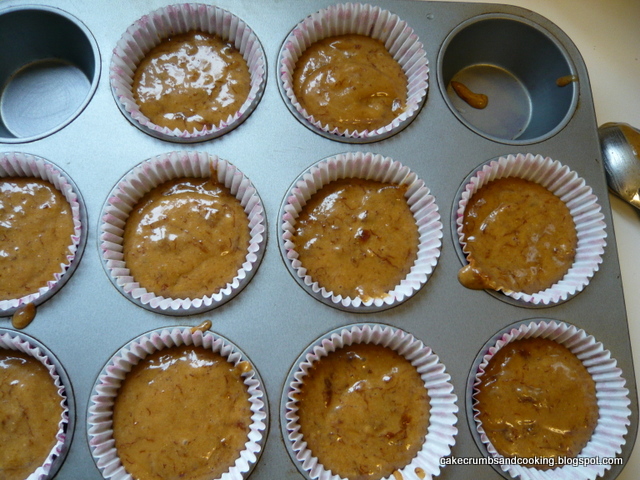
This was then spooned into the waiting muffin cases. I filled them about 2/3 full and really wasn't expecting much of a rise - I think because last time, when I made this as a full cake the middle was a little sunken.


As you can see my 2/3 batter mixture made 10 muffins. And I think I could possibly have squeezed 11 out of the mixture had I been a little meaner when dividing them up. But who wants a mean cake? And I was pleasantly surprised to see a lovely soft little peak on the cakes:


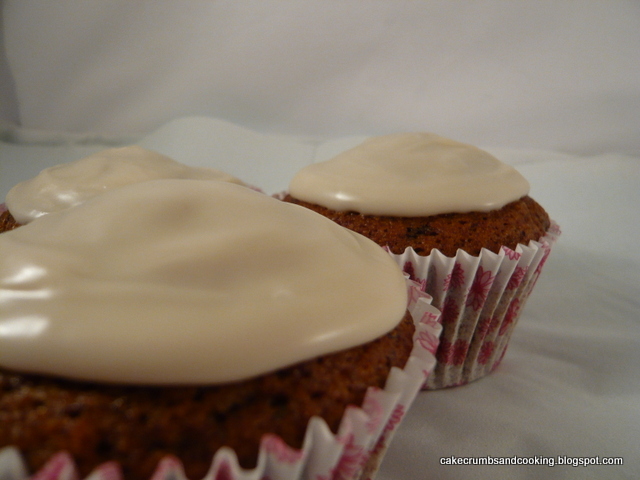
I struggled to know how to decorate these little cakes. When I made the large cake I just left it plain, but small cakes are somehow more demanding of a decoration of sorts. I briefly considered buttercream, but dismissed the idea as too sweet and sickly on top of an already sweet cake. I then decided to make a simple glace icing, but with unrefined icing sugar to give a complementary toffee flavour to that found in the cakes. Sadly, my unrefined icing sugar was clumped and hardened beyond hope of redemption. (And I'm not prepared to whizz it bit by bit in my mini food processor to get it to a useable state again - I don't much enjoy breathing icing sugar!). Back to the drawing board. Then it occured to me that I could use normal icing sugar with a little golden syrup to bring that toffee-ish flavour to the icing. Yum!


So my icing for these buns consisted of about 150g icing sugar, a tbsp of golden syrup and enough water to make a thick icing. It was a tasty icing, and one I'll have to bear in mind for future recipes too.

Verdict? Great recipe - quite time consuming in terms of making the caramel, cooking the banana in it and then leaving to cool but once that bit is done, it's plain sailing. You can see from the picture below just how rich and moist the interior of the cake is - the reddish brown of the caramel definitely comes through. They are light, very banana-ry and very moist and I didn't find them oily at all this time. Sadly I just didn't like them all that much. The cooked strands of banana in the cake were a little offputting and gave a texture I just wasn't keen on. However, this is entirely a personal thing because one of my colleagues said that she thought these were possibly the best cakes I have ever taken to work! I'm glad I gave them another go because I've changed my mind on a couple of things after giving them a second chance, but I'll stick to a more standard banana cake recipe from now on.


Sunday, 4 March 2012

Perfect plain pittas


It's been ages since I've made anything for Short and Tweet, the twitter challenge (#shortandtweet) for baking from Dan Lepard's Short and Sweet organised by @EvidenceMatters. Not because I haven't wanted to, just because I'm disorganised! And seeing all of the excellent pictures other bloggers and twitter folk have taken of the various items that I haven't managed to bake yet is making me want to make them even more.

Lovely soft crumb

One of the challenge recipes for this week was perfect plain pitas, but because I've always known them as pittas, that's how I'm going to carry on spelling them. I very first made these years ago, pre blogging. In fact, I think they were one of the first baked items I ever took photos of, and this is simply because pittas are magic. (It was a fairly short step to both taking pictures of food and blogging it...) You place a fairly thinly rolled out dough into the oven, and then as if by magic you remove a puffed up football of a bread. Aside from the scorching heat needed for these they would be loved by small children for the visual spectacle!

Sticky, sticky dough

Since I have far too much bread in my freezer at the moment (Dill potato, rye sourdough, malted grain amongst them) I opted to make half of the recipe. When I originally made these I used the recipe here, which was originally published by the Guardian in their little 'Guide to Baking' booklet that came out in November 2007. This is a case where the book recipe is identical to the online version. In my half recipe I used 1tsp sugar and miscalculated my water, using 190ml instead of 165ml. Perhaps this is why my dough was wet and sticky. It wasn't too hard to work though. I also missed one of the kneading steps, again with no worries. I remember the pittas as being quite big, so as well as making a half batch I decided I would still make eight. This makes them a more manageable size for my lunch.

Rolled out and resting

Because the pittas need such a high heat I preheated my oven to Gas 8 (nearly as high as it will go) and placed a baking tray in it to warm up. I then shaped my pitta and placed them on a piece of baking parchment on a second tray, to use as a makeshift peel. I only baked two pittas at a time, and this method of transfering them from their unbaked state to the preheated tray was really successful, and I'll do it again.

Rolled out on a piece of parchment, ready to slide onto the waiting hot tray in the oven

When they were puffed up and baked through (6-7 minutes in my oven) I took them out and tipped them onto a napkin, covering them with a second napkin to keep soft and moist.

Puffed and golden, set against the gathering darkness, ow, ow, hot!!

Tender and chewy, these are a million miles from the long-life excuse for pitta bread that you find in the supermarkets.  They were just as successful as I remember them, and I had forgotten that they are relatively quick to make - you don't have to bother waiting for the second prove stage, and once you have a little production line going it's quite fun to keep seeing them pop out all puffed up! My one regret is that my oven has a solid door so I can't see the magic happening!

Perfect plain pitta

Sunday, 22 January 2012

Spelt Ginger Cookies and Rye and Raisin Cookies


This weeks Short and Tweet challenge (#shortandtweet) organised by @EvidenceMatters (blog here) was either Spelt Ginger Cookies (page 245) or Rye and Raisin Cookies (page 247). Or both, if you're greedy and fancy both recipes like me!


I had seen the rye and raisin cookies before, but for some reason they hadn't really appealed to me. However, this time round the recipe looked like just the ticket. I think that the use of an egg white had put me off in the past - I'm not very good at using up the components of eggs separately - I don't go for recipes where they need to be separated (having had a few failures with cakes needing whisked egg whites in the past) and hence have no repertoire of recipes to use up excesses of either yolks or whites. Happily though (and I presume deliberately) the recipes chosen complimented each other perfectly - the spelt ginger cookies requiring the yolk! Very satisfying.


Both of these recipes came together very quickly and easily - I baked them on Sunday morning and was done well before lunch, including the need to bake trays of cookies separately - I think I had about six trays worth of cookies! The spelt ginger ones especially so as they didn't require softened butter or any creaming in the technique. I have to confess that I did actually weigh out the dough into the specified size, so I got almost exactly the number of biscuits given in the recipe. I found that they took seven minutes to bake and achieve the required slightly golden colour.


For the rye and raisin cookies I wanted smaller cookies than specified, I made some with 35g of mixture and some with 25g of mixture, spacing them fairly far apart for the first batch. I didn't have any problems with these running together. I then realised that I had forgotten the bicarbonate of soda specified in the recipe and added it to the remainder of the mixed dough. I don't know whether it was for this reason, or perhaps just that the mixed dough was waiting around for a while, but the next couple of batches seemed to spread quite a bit more - with the result that the second tray had quite a few cookies making friends with each other. I preferred them less spread out, so if this was the effect of adding the bicarb, I'd give it a miss next time - I shall have to peruse other people's blogs to find if their cookies also spread out or not! I also found that inspite of making my rye and raisin cookies smaller than the specified size, they took longer to cook. Hmm, don't know why! I baked mine for about 20 minutes - at the specified 12-15 mins they looked very soft indeed.


I was prepared not to like the rye and raisin cookies. I don't really know why. Perhaps it's the slight nubbliness of the rye flour (which didn't really come through in these cookies), or my sort-of-indifference to raisins in some situations. Dan notes that if you don't have a very sweet tooth you can reduce the sugar slightly. I reduced the quantities of both types of sugar by about 15g and thought the cookies were still lovely and sweet. Well, I was pleasantly surprised because these were delicious. The rye, raisin and chocolate blended really well flavourwise, and the texture of slightly crispy and sugary and then chewy raisin was great.


I hadn't seen the recipe for the spelt ginger cookies before (I don't think it's a recipe from Dan's Guardian column) but a little googling will find it without too much trouble. I have to say that of the two recipes, this is the one that really, really appealed to me. And I wasn't let down. I love ginger flavoured cakes and biscuits and these were really good. I had a couple almost straight out of the oven and they were utterly delicious - slightly crispy edges and a great chewy centre, gently spiced with ginger and lovely little nubbles of stem ginger to add a bit of bite. My only regret was that after only a couple of days they had softened significantly and were just chewy without the delicious contrast of crispness round the edge that I had so enjoyed the first day. I wonder if they could be re-crisped in the oven? It seems a shame because the recipe makes quite a large batch and it would be nice to keep them for a week or so. Aside from this they were superb.


The use of wholemeal flour (rye or spelt) in these biscuits doesn't make them health food by any stretch of the imagination, but the knowledge that you are taking on a little more fibre than might be expected from a sweet treat does no harm, and without being told that these recipes were made with wholemeal flour you certainly wouldn't have guessed. I fear that I am beginning to sound like a scratched record, but both of these recipes were excellent and I wouldn't hesitate to recommend them (oh, and recommend buying the book too!).

Thanks to EvidenceMatters for excellent choices for this week, which again, I probably wouldn't have made on my own.

Sunday, 15 January 2012

Soft White Baps


These were one of the choices for this week's Short and Tweet challenge (organised by @EvidenceMatters, you can find the blog here) baking from Dan Lepard's book Short and Sweet. The other choices were Superwraps and Cider Vinegar Muffins, both of which I also want to make, but ran out of time (and freezer space for storage!).

I have made these before from the recipe published on the Guardian website here, and you can see what I thought of them then here.

Some more thoughts on the dough and the process this time. I used my danish dough whisk to mix the sponge ingredients and rather lazily left it in the dough so I could use it to mix in the remaining ingredients. It amused me greatly to see it gradually disappear until only the imprint of the whisk was left as the sponge rose!


Going...


Going...


Gone!!!
I followed the recipe ingredients fairly closely, but my timings were all over the place. I left the sponge for far longer than it should have had (closer to 5 hours!), the intervals for mixing the dough were rather stretched, but the final proove of the buns was much shorter - they just seemed to grow quickly and although I was aiming for the batched effect I didn't want them to become one ginormous bun!
Just before baking, dusted with lots of flour

I found that the dough was incredibly sticky to work with - I really needed my dough scraper to have  a hope of kneading it that first time, but after the first time the dough was much better behaved and less sticky, but still very soft and floppy. Looking back at the notes I made last time, I also found this to be the case then.

Sticky bowl - very soft dough
The changes I made to the ingredients are that I halved them - I made nine buns out of my half, each ball of dough weighing around 85g, which will be a good lunch size - the original nine would be massive and I'd need to snooze after lunch, which I'm not entirely sure would go down well with my colleagues! I used 30g butter rather than 37g, and reckoned on a tbsp of cornflour being 15g (this is probably incorrect, but I used the weights rather than measuring). I also cut the sugar and used 15g rather than 25g.

I baked at 200C/Gas 6 for 20 minutes, after dusting the buns heavily with flour to protect the tops from burning. When I'm having soft white bread I don't really like a dark crust. These tactics worked well and I have ended up with beautifully soft white bread with a close crumb, delicious for sandwiches.

Since I'm a little late getting this post up I will have to add further notes about taste and texture when I've actually had a chance to eat them, but they do feel just as soft as I remember them - i.e. the softest buns I've ever made! I think it might be interesting to try this recipe as half wholemeal or half spelt and see if the cornflour has the same softening effect when combined with a partly wholemeal flour - healthier too!

Update 16/01: Well, these are delicious and my lunch today was very enjoyable. A truly soft squashy bun, but springy too, in the sense that once you've squashed them they don't disintegrate to a disgusting dough texture (supermarket buns I'm looking at you) but spring back to be soft and squashy again. Win! These would be perfect rolls for a child's lunchbox if you have a fussy wholemeal hating child who wants shop bought bread and to be identical to their friends. The only difference is that these taste homemade - i.e. delicious. They are unashamedly a white yeasted roll though - there is none of the complexity of flavour that you get from the incorporation of other flours or any seeds or using sourdough rather than yeast and so forth, but they certainly deliver what they promise. They'll certainly be welcome in my lunchbox this week.

Wednesday, 4 January 2012

The Alchemist's Chocolate Cake


I have wanted to make this cake for such a long time, and really don't know why I haven't got round to it before now. The recipe was first published in the Guardian here, in June 2008. Why, oh why haven't I made it before now? And indeed, why now after all this time? Well, this is one of the three cakes in this week's Short and Tweet challenge - there are some choices of what to make each week from now on. You can see the January schedule here. So again, thanks go to @EvidenceMatters for the prompt and prod to finally get round to making this cake. I won't be doing the other two cakes for this week though - I don't do coconut and the Saffron Peach cake, delicious though it sounds, relies on almonds for flavour and texture to an extent that I can't really sub them out.


There are some small changes from the online recipe to the one printed in Short and Sweet, and I used the book version - you'll have to buy it to find out what they are, presumably Dan tweaked it to make a better cake before publishing it in printed book form.

The alchemy of the name presumably comes from the making of a delicious, moist, marvellously chocolatey cake (can you tell that I liked this one yet?!) that is very low in fat (only 50ml of fat in the whole cake!) but doesn't taste in the slightest bit 'worthy'.


It was nice and straightforward to make - one of those cakes where it's almost more work to line the tin than make the cake (note to self, buy some of those handy silicon cake tin liners from Lakeland!) but I found that mine needed quite a bit longer for me to be sure that it was cooked. I think that actually, it possibly was cooked at the time specified in the recipe, but I probably left it about 20 minutes longer, covered with foil, to make sure it was done. The moistness doesn't seem to have suffered from this prolonged stay in the oven. The only substitution I made was to use a light olive oil instead of the specified walnut oil, for allergy reasons. Perhaps I did lose a little of the subtle flavour, but at least I could eat the cake!!!


The crumb is quite sturdy, which is perfect for me to take to work. I guess that the removal of fat means that a soft, crumbly crumb is the forfeit. I suppose I could have used some of my chocolate essence to enhance the chocolatey flavours, and maybe next time, but for the first time I just wanted to experience the cake as it was intended. The cake was lovely and chocolatey and I couldn't really taste pears at all, which I guess is the idea. I could detect a slight graininess from the pears though, which I didn't mind, as I knew what it was, but I suppose it might be slightly odd if you didn't know where it had come from.

The day after it was baked it had developed a very shiny surface. Not sure why this was, but it was actually quite pretty. I cut my cake into 16 (anticipating work colleagues not wanting cake at this time of year!) and this means that a slice of cake works out at fewer calories than two digestive biscuits. And who would choose to eat two boring digestives when they could have a slice of delicious chocolate cake instead!!!


So, since this is positively health food I'm also submitting it as my 'We Should Cocoa' entry this month. Chele at Chocolate Teapot is our host for January and the theme is chocolate with a health concious slant. I think this fits the bill perfectly!


Since I've genuinely had this bookmarked for years and years, I'm entering it into Jac's Bookmarked Recipes linky over at Tinned Tomatoes. I'm very glad I finally got round to making it and would recommend it.

LinkWithin

Related Posts Plugin for WordPress, Blogger...